
Finding the best geotextile fabric for a French drain is essential for keeping soil out of the drainage gravel while allowing water to pass through. The right filter fabric helps reduce sediment buildup, protects the drainage aggregate, and supports the long-term performance of a properly designed French drain. Choosing ordinary weed-barrier fabric instead of a suitable drainage geotextile can lead to poor filtration and clogging.
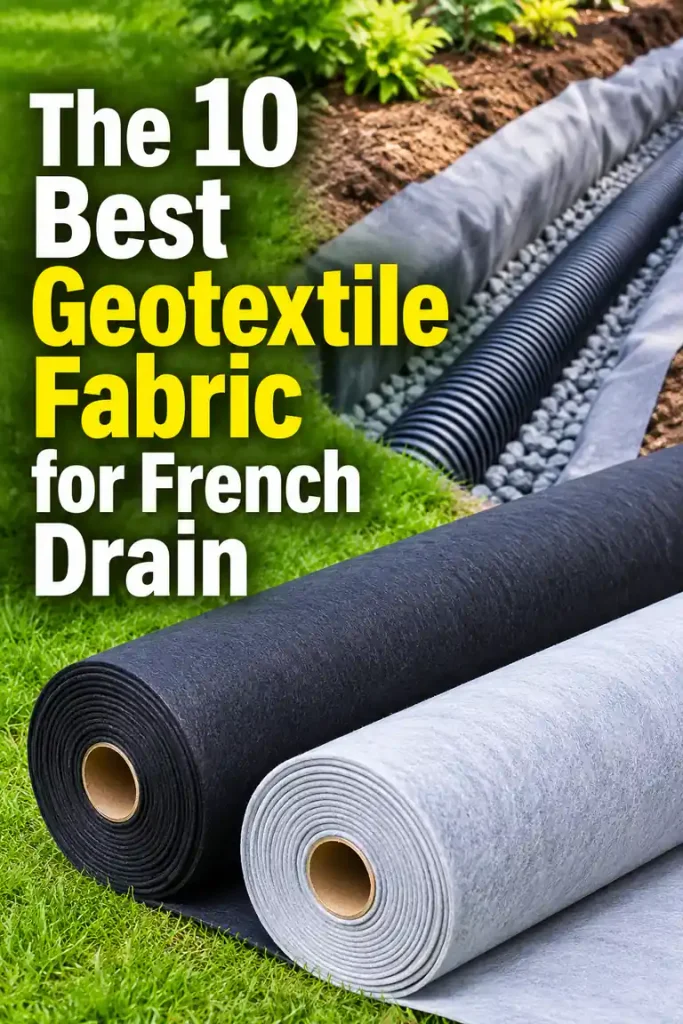
For many residential French drains, needle-punched nonwoven geotextile is a practical starting point. The ideal product depends on soil type, water flow, trench conditions, and the fabric’s filtration specifications—not simply its thickness or advertised weight. This guide compares ten options and explains what to look for before buying.
Top 10 Best Geotextile Fabric for French Drain: Comparison Table
| Product Name | Best For | Check Price |
|---|---|---|
| 1. US Fabrics 160NW Nonwoven Geotextile | General drainage and filtration | Check on Amazon |
| 2. Mirafi 140N Nonwoven Geotextile | Residential drainage projects | Check on Amazon |
| 3. VEVOR Nonwoven Geotextile Fabric | DIY drainage and larger coverage areas | Check on Amazon |
| 4. Mutual WF200 Geotextile | Drainage and soil separation | Check on Amazon |
| 5. 4 oz Nonwoven Geotextile Filter Fabric | Typical residential French drains | Check on Amazon |
| 6. 6 oz Nonwoven Geotextile Fabric | More demanding DIY drainage installations | Check on Amazon |
| 7. 8 oz Nonwoven Geotextile Fabric | Projects needing greater handling durability | Check on Amazon |
| 8. Pro Fabric Supply Nonwoven Drainage Fabric | Drainage-specific fabric by roll | Check on Amazon |
| 9. US Fabrics Nonwoven Filter Fabric Rolls | Longer trench runs and larger projects | Check on Amazon |
| 10. Nonwoven Geotextile Filter Fabric for French Drains | Budget-conscious project comparisons | Check on Amazon |
Affiliate disclosure: As an Amazon Associate I earn from qualifying purchases.
1. US Fabrics 160NW Nonwoven Geotextile
Best for: General drainage and filtration applications
US Fabrics 160NW is a nonwoven geotextile option worth investigating for French drains and other subsurface drainage projects. A suitable nonwoven filter fabric separates surrounding soil from the drainage aggregate while allowing water to pass through. This helps limit the migration of soil particles into the gravel bed, where accumulated fines can reduce the space available for water movement.
The main reason to consider a purpose-made geotextile is that drainage fabric needs to do more than cover the ground. It must provide suitable filtration, water permeability, and resistance to damage during installation. A product with a technical data sheet makes it easier to compare those properties against the soil and drainage requirements of your project.
Before purchasing US Fabrics 160NW, verify the precise product designation and its current specifications. Do not assume every listing using the US Fabrics name has identical dimensions or properties. Also check whether the available roll width is suitable for wrapping the gravel-filled trench with enough fabric left for the required overlap.
For a typical residential installation, this type of product may be a sensible starting point if its filtration characteristics match the surrounding soil. If your site contains very fine silt or clay, seek guidance on apparent opening size and permeability rather than choosing based on product name alone.
Pros
- Nonwoven construction is suitable for investigating drainage-filter applications.
- Can help separate surrounding soil from drainage aggregate.
- Useful as a candidate for residential and landscaping drainage.
- Technical specifications can support more informed comparisons.
- Roll format may suit continuous trench installations.
Cons
- The exact listing and specifications must be verified.
- May cost more than basic weed-barrier fabric.
- Correct selection depends on soil and filtration requirements.
- Roll width and length may not match every trench.
Buying advice: Consider US Fabrics 160NW if you want a purpose-made nonwoven geotextile. Verify the product code, filtration specifications, roll size, and compatibility with your soil before buying.
2. Mirafi 140N Nonwoven Geotextile
Best for: Residential drainage projects where a specified geotextile is preferred
Mirafi 140N is another geotextile product to investigate when comparing materials for drainage and soil separation. A product with documented engineering properties is especially helpful when you want to move beyond generic landscape fabric and evaluate whether the material can filter the surrounding soil while allowing water to enter the drainage zone.
For a French drain, the fabric generally needs to keep fine soil from migrating into the stone without restricting water flow excessively. The right balance depends on the soil particle distribution, the expected water movement, and the installation design. A fabric that works well in coarse sandy soil may not be the best choice for a site dominated by fine silt or clay.
Before choosing Mirafi 140N, confirm the current manufacturer’s technical data and the exact product being offered. Check the apparent opening size, permittivity or other relevant hydraulic data, strength properties, and recommended applications. These specifications are more useful than relying on a product title or a broad claim that the fabric is heavy-duty.
Also consider installation conditions. The fabric may be exposed to sharp aggregate, rough trench walls, and handling stresses during placement. If your trench is especially rocky or deep, make sure the selected grade can withstand those conditions.
Pros
- A named geotextile product to compare against project specifications.
- Useful for evaluating documented filtration and strength properties.
- Can be considered for drainage and soil-separation applications where specified.
- More informative than choosing fabric solely by appearance.
- Supports comparison based on technical data.
Cons
- Current availability and exact product details need verification.
- Not every geotextile grade is appropriate for every soil.
- May be more than a small, simple DIY project requires.
- Correct selection may require technical guidance for difficult soil.
Buying advice: Choose Mirafi 140N only after confirming the current specifications and intended use. Match its filtration characteristics to your site rather than assuming any nonwoven fabric will work equally well.
3. VEVOR Nonwoven Geotextile Fabric
Best for: DIY French drains and projects requiring a larger roll
VEVOR nonwoven geotextile fabric is worth comparing for homeowners who need a roll for a drainage trench, garden drainage improvement, or other landscaping project. Larger rolls can simplify installation by reducing the number of seams and helping you cover the intended trench length in continuous sections.
The crucial detail is the exact product specification. VEVOR listings can include different dimensions, weights, and fabric types. Confirm that the particular roll is a nonwoven geotextile intended for drainage or filtration, rather than assuming every fabric sold under a similar category is interchangeable.
Roll dimensions affect both convenience and cost. A wider roll may make it easier to line the trench and fold the fabric over the gravel, while a narrower roll can be easier to handle in a confined space. Calculate the required width before ordering so you do not end up with fabric that is too narrow to provide the intended coverage and overlap.
Check the product description for the material, stated weight, strength information, and water-flow characteristics. Customer reviews and photos may help you assess packaging and handling, but they cannot replace technical data when filtration performance is important.
Pros
- Available in different roll sizes across product listings.
- Can be convenient for DIY and landscaping projects.
- Larger rolls may reduce the number of seams.
- Useful for comparing cost per square foot or square yard.
- May suit buyers looking for a practical roll format.
Cons
- Specifications can vary between listings.
- Not every landscape fabric is suitable as a drainage filter.
- Marketing descriptions may not provide enough filtration data.
- Heavy fabric can be awkward to position in narrow trenches.
Buying advice: Consider VEVOR if the exact listing provides the nonwoven construction, dimensions, and technical details your project needs. Compare the total usable area and specifications, not just the advertised roll price.
4. Mutual WF200 Geotextile
Best for: Drainage and soil-separation projects that need a specified material
Mutual WF200 is a product name to investigate when comparing geotextiles for drainage-related applications. For a French drain, the goal is to select a filter that separates native soil from the aggregate without creating an excessive barrier to water movement.
A geotextile’s performance is not determined by weight alone. Two fabrics with similar weights can have different pore characteristics, permeability, and mechanical strength. That is why it is important to review the technical information for the exact grade rather than selecting whichever roll appears thickest.
When considering Mutual WF200, verify the manufacturer’s current documentation and whether the specific grade is suitable for your intended drainage installation. Pay attention to the stated applications, apparent opening size, water-flow characteristics, and strength data. These properties help determine whether the fabric is suitable for the soil and conditions at your site.
For a small residential French drain, an appropriate nonwoven fabric may be sufficient. If the drain is intended to protect a foundation, retain a slope, or handle a substantial amount of groundwater, the consequences of choosing an unsuitable filter can be more serious. In those situations, follow the project design or seek professional advice.
Pros
- Named product to research for drainage-related applications.
- Allows comparison using documented technical specifications.
- Can be evaluated for soil separation and filtration needs.
- Encourages selection based on performance data rather than appearance.
- May suit projects where a specified geotextile is required.
Cons
- Exact grade and availability must be confirmed.
- Compatibility depends on the surrounding soil and project design.
- Technical data may need interpretation.
- May not be necessary for a very small, low-risk drainage project.
Buying advice: Confirm that the exact Mutual WF200 product is suitable for your intended French drain. If its documentation does not establish the required filtration performance, compare another product with clearer specifications.
5. 4 oz Nonwoven Geotextile Filter Fabric
Best for: Many ordinary residential drainage projects, when soil conditions are suitable
A 4 oz nonwoven geotextile is a common specification to investigate for residential French drains. The weight refers to the fabric’s mass per square yard, not a direct measurement of how quickly water will pass through it. A 4 oz fabric can be appropriate for some projects, but it is not automatically the best option for every soil or installation.
For a relatively straightforward trench, a suitable 4 oz fabric may offer a useful balance of handling strength, filtration, and flexibility. Nonwoven construction creates a network of fibers that can retain soil particles while allowing water to move through the material. That function is different from the weed suppression provided by many woven landscape fabrics.
The right selection still depends on the fabric’s actual technical properties. Look for information about apparent opening size, permittivity, tensile strength, and puncture resistance. These specifications help you assess whether the fabric can retain the soil at your site and withstand installation.
A lightweight fabric may be easier to fold around the gravel, but it can be more vulnerable to tearing when handled against sharp stone. Inspect the product details and decide whether its strength is suitable for your trench depth, aggregate, and installation method.
Pros
- A practical specification to compare for residential drainage.
- Often easier to handle than very heavy fabric.
- Flexible enough to wrap around a gravel-filled trench.
- Can provide a balance of filtration and handling strength when properly specified.
- Available in various roll dimensions.
Cons
- Not necessarily suitable for every clay- or silt-heavy soil.
- Weight alone does not establish filtration performance.
- May be vulnerable to damage from sharp aggregate.
- Product quality can vary by manufacturer.
Buying advice: Consider 4 oz nonwoven geotextile for an ordinary residential French drain only after checking its technical data and matching it to your soil. Do not use the weight rating as the sole buying criterion.
6. 6 oz Nonwoven Geotextile Fabric
Best for: DIY drainage projects that need a balance of filtration and handling durability
A 6 oz nonwoven geotextile is another specification worth comparing when building a French drain. It may be useful where installation involves rougher trench conditions or where you want more resistance to handling damage than a lighter fabric provides. However, a heavier material is not automatically better for water flow or soil retention.
The fabric must perform two related tasks: retain enough soil to protect the drainage aggregate and allow water to pass through at the rate the system requires. A heavier product may offer greater mechanical strength, but its hydraulic properties still need to be checked. The correct balance depends on the site’s soil, the drainage design, and the product’s measured performance.
A 6 oz fabric can also be more substantial to fold and overlap, especially in a narrow trench. Plan the layout before filling the trench with stone, and make sure the roll is wide enough to wrap the aggregate with the required overlap.
If your property has heavy clay or fine silt, avoid choosing a fabric simply because it is thicker. Soil compatibility and filtration criteria are especially important in fine-grained soils. Where drainage protects a building or retaining structure, use the specified material if the project design provides one.
Pros
- Worth considering where installation strength matters.
- May be more resistant to handling damage than lighter fabrics.
- Nonwoven structure can be suitable for filtration when correctly specified.
- Available in different roll sizes.
- Useful for comparing medium-weight geotextile options.
Cons
- Heavier fabric can cost more and be harder to handle.
- Greater weight does not guarantee better water flow.
- Must still be matched to the soil.
- Specifications vary by manufacturer.
Buying advice: Compare 6 oz nonwoven fabric when you need a more robust material, but check permeability, apparent opening size, and strength data before deciding it is suitable.
7. 8 oz Nonwoven Geotextile Fabric
Best for: Drainage installations where additional handling durability may be needed
An 8 oz nonwoven geotextile may be worth considering for demanding installation conditions, such as trenches with rough surfaces or aggregate that could damage a lighter material. The heavier construction can offer additional resistance to physical handling, depending on the specific product’s strength and puncture-resistance properties.
However, choosing the heaviest fabric available is not a reliable shortcut. French drain fabric must allow water to enter the gravel while retaining the surrounding soil. A heavier fabric with unsuitable hydraulic properties may not perform as well as a lighter, correctly specified drainage filter.
For this reason, compare technical data rather than relying on ounce weight alone. Check the product’s apparent opening size, permittivity, tensile strength, and puncture resistance. If the manufacturer provides a recommended application range, make sure it covers your project.
Also consider how the material will be installed. A heavier roll may be harder to position and fold neatly, particularly when working alone. Make sure the trench width, roll width, and intended wrap method are compatible before starting.
Pros
- Worth comparing for rougher installation conditions.
- May offer greater mechanical durability, depending on its specification.
- Nonwoven options can support drainage filtration.
- Useful where fabric may encounter sharp aggregate during installation.
- Available in various roll formats.
Cons
- May be more expensive than lighter options.
- Can be harder to fold and handle in narrow trenches.
- Higher weight does not automatically mean better filtration.
- Could be unnecessarily robust for a simple residential drain.
Buying advice: Consider 8 oz nonwoven geotextile only when the installation conditions justify it and the technical data supports the required water flow and soil retention. For routine drainage, compare it carefully with lighter grades.
8. Pro Fabric Supply Nonwoven Drainage Fabric
Best for: Buyers looking for drainage-specific fabric in roll quantities
Pro Fabric Supply offers drainage-fabric buying guidance and products that can be useful when comparing nonwoven filter materials. For a French drain, a supplier focused on geotextile applications can help you understand differences in fabric weight, roll dimensions, and filtration characteristics.
The main advantage of looking at drainage-specific fabric is the opportunity to compare more than a generic landscape-fabric label. Technical information can help you determine whether the fabric is intended to filter soil around drainage aggregate or primarily to control weeds on the surface.
Before buying, confirm the exact product and its specification. Check whether the listing identifies a nonwoven needle-punched construction, the material type, weight, roll size, and relevant hydraulic and strength data. If you cannot find these details, ask the supplier for a technical data sheet before relying on the fabric for a critical drainage installation.
Roll quantity also matters. A large roll may be economical for a long trench, but it may leave you with unnecessary material for a small repair. Calculate the required area and allow for the overlap and folds specified by your installation plan.
Pros
- Useful source for comparing drainage-specific fabric options.
- Can help buyers focus on filtration rather than weed suppression.
- Roll formats may suit longer trench installations.
- Technical specifications can make product comparisons easier.
- Useful for checking different weight categories.
Cons
- The exact product and current listing must be verified.
- Shipping and roll dimensions may affect total cost.
- Not every grade will suit every soil.
- A supplier’s general guide does not replace project-specific specifications.
Buying advice: Use Pro Fabric Supply as an option to research, and confirm the exact product specifications before purchase. Compare total coverage, delivery costs, and filtration performance with other drainage fabrics.
9. US Fabrics Nonwoven Filter Fabric Rolls
Best for: Longer French drain runs and larger drainage projects
For a long French drain, buying a roll of nonwoven filter fabric can simplify installation and reduce the number of joints. US Fabrics is a manufacturer worth investigating when you need a geotextile roll and want to compare product specifications rather than shop solely by appearance.
The right roll depends on the trench’s dimensions and the required wrap. The fabric usually needs enough width to cover the bottom and sides of the trench, extend around the drainage stone, and overlap at the top according to the design. Ordering a roll that is too narrow can create unnecessary seams or leave part of the aggregate exposed to surrounding soil.
For longer runs, also consider the practicalities of handling the roll. A wide, heavy roll can be cumbersome to position, while a narrower roll may be easier to manage but require more careful planning. Compare the price per usable square foot or square yard rather than just the overall roll price.
Confirm that the exact product is nonwoven and intended for filtration. Check its technical data against your soil and installation requirements, and do not assume that every product from the same manufacturer has the same properties.
Pros
- Roll format can suit longer drainage trenches.
- May reduce the number of fabric seams.
- Offers an opportunity to compare documented geotextile specifications.
- Useful for estimating coverage across a larger project.
- Can be evaluated against other drainage fabric brands.
Cons
- Larger rolls may be difficult to handle.
- Roll width must match the trench layout.
- Shipping can influence the final price.
- The exact grade still needs to be selected for the soil.
Buying advice: Consider a US Fabrics nonwoven roll for a larger project if the product’s specifications meet your drainage needs. Measure carefully and confirm the exact grade, roll dimensions, and shipping cost before ordering.
10. Nonwoven Geotextile Filter Fabric for French Drains
Best for: Budget-conscious shoppers comparing multiple drainage-fabric brands
If you are not committed to a particular manufacturer, searching specifically for nonwoven geotextile filter fabric for French drains can help you compare available roll sizes and prices. This approach is useful for small DIY projects where several products may appear similar but differ in weight, construction, and technical documentation.
The most important step is to separate actual geotextile filter fabric from ordinary landscape cloth. Many weed barriers are sold for landscaping, but they are not automatically suitable for subsurface drainage. For a French drain, look for a product explicitly described for drainage or filtration and verify that the specifications support that application.
Check whether the listing gives the material type, weight, dimensions, and technical performance information. If it only says “heavy-duty” or “water-permeable” without meaningful specifications, you may not have enough information to judge its suitability.
A budget product can be reasonable for an appropriate low-risk project, but price should not outweigh filtration compatibility. Replacing a failed French drain can involve digging up the gravel and pipe, so choosing a suitable fabric from the start can be more economical than saving a small amount on an unsuitable material.
Pros
- Makes it easy to compare multiple brands and roll sizes.
- May reveal budget-friendly options.
- Useful for checking availability for smaller projects.
- Allows comparison of price per unit area.
- Can help identify drainage-specific nonwoven fabrics.
Cons
- Listings vary widely in quality and documentation.
- Some search results may be weed barriers rather than geotextiles.
- Low prices do not guarantee suitable filtration.
- Product details must be checked carefully.
Buying advice: Use a general search to compare products, but purchase only after confirming the fabric’s nonwoven construction, drainage application, technical properties, and usable dimensions.
How to Choose the Best Geotextile Fabric for a French Drain
1. Choose nonwoven fabric intended for drainage
For many conventional residential French drains, needle-punched nonwoven geotextile is the most useful type to investigate. Its random fiber structure can allow water through while helping retain soil particles.
Do not confuse geotextile filter fabric with ordinary woven weed-barrier cloth. The latter may be designed primarily to suppress weeds, not to provide the filtration characteristics needed around drainage aggregate.
2. Match the fabric to your soil
Soil type affects which fabric will work best. Coarse sandy soil, silty soil, and clay-heavy soil have different particle sizes and filtration requirements.
A fabric with openings that are too large may allow excessive soil migration. One that is poorly matched to fine soil may clog or restrict flow. If your soil contains a lot of fine silt or clay, review the apparent opening size and hydraulic properties, and follow a project specification or professional guidance where necessary.
3. Compare weight without relying on it alone
Geotextile weight is commonly expressed in ounces per square yard or grams per square meter. A heavier fabric may offer more resistance to installation damage, but it does not automatically provide better drainage.
Compare weight alongside:
- Apparent opening size (AOS).
- Permittivity or other water-flow data.
- Tensile strength.
- Puncture resistance.
- The manufacturer’s stated applications.
4. Check roll width and length
The fabric must be wide enough to cover the planned trench lining or wrap around the drainage aggregate with the required overlap. Measure the trench and follow the installation design before ordering.
A roll that is too narrow may create extra seams or leave areas unprotected. A roll that is much larger than necessary may increase cost and create storage waste.
5. Consider installation durability
Fabric can be torn by sharp stone, rough trench walls, careless handling, or heavy backfill. Check the product’s strength data and handle it carefully during installation.
If the trench is deep, rocky, or subject to heavy loading, the design may require a more robust material. Do not assume that increasing fabric weight alone resolves every durability issue.
6. Verify product documentation
A trustworthy product listing should provide enough information to identify the actual material and its intended use. Prefer a manufacturer technical data sheet over vague claims such as “professional grade,” “extra strong,” or “best drainage fabric.”
For demanding projects, make sure the fabric meets the project’s engineering specification or applicable local requirements.
7. Calculate total cost, not just the roll price
Compare the total usable area, roll width, shipping, and amount of overlap required. A lower-priced roll may not be a better value if it is too narrow, has insufficient documentation, or is unsuitable for the soil.
How to Install Geotextile Fabric in a French Drain
Step 1: Plan the drainage route
Determine where water will collect and where it can safely discharge. The trench, pipe, gravel, and outlet must work together. Fabric cannot compensate for an inadequate outlet or a poorly designed drainage route.
Step 2: Excavate the trench
Dig the trench according to the intended depth, width, slope, and local requirements. Remove loose debris and sharp objects that could damage the fabric. If the drain is near a building foundation or buried utilities, check the relevant safety and installation requirements before digging.
Step 3: Prepare the fabric
Cut a length of fabric wide enough for the planned installation. In many conventional French drains, the geotextile lines the trench and wraps around the drainage aggregate, but the correct arrangement depends on the design.
Keep the fabric clean while handling it. Avoid dragging it across sharp stones or leaving it exposed to unnecessary damage before placement.
Step 4: Line the trench
Place the fabric so it covers the intended surfaces and leaves enough material on each side to fold over the gravel later. Avoid stretching it tightly or leaving large gaps where soil can enter the drainage stone.
Follow the design for seams and overlaps. The required overlap depends on the installation and project specification; do not assume one measurement applies to every situation.
Step 5: Add clean drainage aggregate
Place the specified drainage stone without tearing or puncturing the fabric. Use clean aggregate suitable for the drain design, and avoid mixing it with excavated soil.
The amount and size of the stone should be determined by the project’s requirements rather than by fabric selection alone.
Step 6: Install the perforated pipe if required
Place the drainage pipe according to the design, including the intended orientation and slope. Confirm that the pipe connects to a suitable outlet and that water can leave the system.
A pipe sock may help filter particles at the pipe itself, but it does not necessarily replace the geotextile needed to separate surrounding soil from the gravel bed.
Step 7: Complete the aggregate wrap
After placing the required gravel, fold the fabric over the top so the drainage aggregate is separated from the surrounding backfill. Keep the overlap secure according to the project design and avoid leaving open gaps.
Step 8: Backfill carefully
Add the specified backfill or surface material without damaging the fabric or disturbing the drainage components. If the surface will support vehicles, structures, or other substantial loads, follow the appropriate engineered design.
Step 9: Check the outlet
Make sure the discharge point remains open and water can flow away as intended. A properly selected fabric cannot solve a blocked outlet, inadequate slope, or undersized drainage system.
Common Mistakes to Avoid
Using ordinary weed-barrier fabric
A weed barrier may look similar to geotextile, but its intended function can be different. Choose a fabric specified for drainage filtration rather than relying on appearance.
Wrapping only the pipe without considering the gravel bed
A pipe sock may protect the perforations, but fine soil can still enter the surrounding gravel if the overall system lacks appropriate soil separation. Follow the design for protecting the drainage aggregate.
Assuming heavier fabric is always better
Higher weight can improve some mechanical properties, but it does not automatically mean better water flow or soil retention. Compare the actual technical specifications.
Leaving gaps in the fabric
Unprotected areas can allow soil to migrate into the gravel. Plan the fabric width and overlaps before filling the trench.
Using dirty or unsuitable aggregate
Soil and fine debris mixed into the gravel can reduce the space available for water movement. Use the aggregate specified for the drainage system and keep it clean during installation.
Ignoring the outlet and slope
French drains depend on a suitable path for water to exit. A correctly installed fabric will not fix an outlet that is blocked or a trench that fails to direct water properly.
Choosing without checking the product data
A product title alone does not establish its suitability. Verify the material, intended use, dimensions, and filtration and strength specifications.
Frequently Asked Questions
What is the best geotextile fabric for a French drain?
For many conventional residential French drains, needle-punched nonwoven geotextile is a practical starting point. The best product depends on the soil, required filtration, water flow, and installation conditions. Check the technical data instead of choosing by brand or weight alone.
Is woven or nonwoven fabric better for a French drain?
Nonwoven geotextile is commonly used for French-drain filtration because its fiber structure can allow water through while retaining soil particles. Woven geotextiles can be suitable for some engineered applications, but ordinary woven weed-barrier fabric should not automatically be treated as a drainage filter.
Is 4 oz geotextile fabric enough for a French drain?
It may be suitable for some residential projects, but weight alone cannot determine whether a fabric is appropriate. Check its filtration properties, strength, and compatibility with the surrounding soil.
Should I use 6 oz or 8 oz geotextile fabric?
That depends on the installation and the product’s technical specifications. Heavier fabric may offer greater resistance to handling damage, but it is not automatically better for filtration or water flow. Match the fabric to the soil and project requirements.
Can I use landscape fabric for a French drain?
Only if the specific product is actually suitable for subsurface drainage and filtration. Many ordinary landscape fabrics are intended for weed suppression and may not provide the necessary performance. Look for drainage-specific nonwoven geotextile with documented specifications.
Should geotextile fabric wrap the pipe or the gravel?
The correct arrangement depends on the drain design. In many conventional French drains, the fabric separates the surrounding soil from the gravel-filled drainage zone. A pipe sock alone may not protect the gravel from soil infiltration. Follow the design and manufacturer’s installation guidance.
Does geotextile fabric stop French drains from clogging?
It helps reduce clogging by limiting soil migration into the drainage aggregate, but it cannot guarantee that a drain will never clog. Soil conditions, fabric selection, aggregate cleanliness, pipe layout, and outlet maintenance all affect performance.
How much geotextile fabric do I need?
Measure the trench length and calculate the width needed to line the intended surfaces and wrap the aggregate, including the required overlap. Add an allowance for seams, cuts, and waste. Use the installation design’s overlap requirements rather than assuming one width works for every trench.
Can geotextile fabric be used in clay soil?
It can be used in suitable drainage designs, but clay and fine silt require careful filtration selection. A fabric that is not matched to the soil may clog or allow unwanted soil movement. For foundation drainage or difficult soil conditions, use a specified design or seek professional guidance.
How long does geotextile fabric last underground?
Service life depends on the fabric material, product quality, soil chemistry, installation damage, and operating conditions. Do not assume a specific lifespan from the fabric weight alone. Choose a suitable product and install it according to its technical guidance.
Where can I buy geotextile fabric for a French drain?
The Amazon links in this guide provide searches for named products and specification-based options. Check the exact listing, dimensions, intended application, technical data, seller, and delivery cost before ordering.
Final Words
The best geotextile fabric for a French drain is one that retains the surrounding soil, allows water to pass through, and withstands the conditions of installation. Nonwoven geotextile is a practical choice for many residential drainage systems, but the correct grade depends on soil type, filtration needs, and the drain’s design.
Compare named products such as US Fabrics 160NW and Mirafi 140N with suitable nonwoven options in 4 oz, 6 oz, and 8 oz specifications. Verify the exact technical data and roll dimensions before buying, and avoid treating ordinary weed-barrier fabric as an interchangeable substitute. Proper fabric selection, clean aggregate, a correctly installed pipe, and a reliable outlet all contribute to a French drain that performs as intended.