
Sewing clips are handy alternatives to straight pins when you need to hold fabric layers together before stitching. They are especially useful for quilting, bag making, binding, and working with materials such as vinyl or faux leather that can retain visible pinholes. The best sewing clips provide a dependable grip, open easily, and hold fabric without making it difficult to guide the edge through your sewing machine.
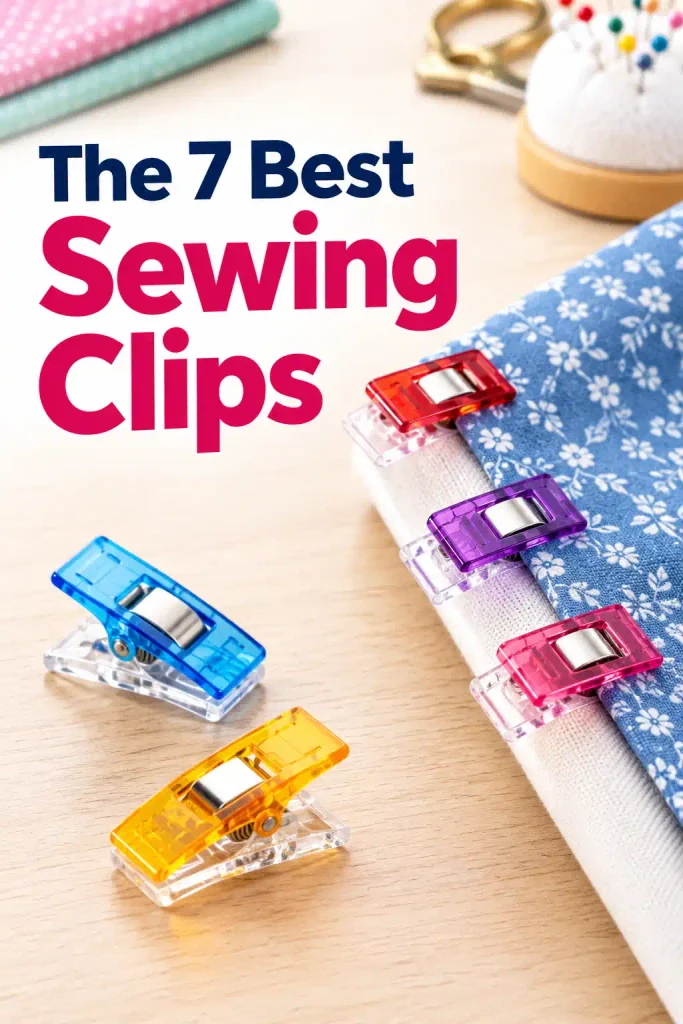
Whether you are a beginner building a sewing kit or an experienced quilter looking for better ways to manage bulky layers, choosing the right clips can make your projects easier to handle. In this guide, we cover seven sewing clip options and explain what to look for before purchasing.
Our Top Picks
- Best Overall: Clover Wonder Clips — Check on Amazon
- Best for Small Projects: Clover Mini Wonder Clips — Check on Amazon
- Best for Quilting: Jumbo Quilting Clips — Check on Amazon
- Best Budget Option: Multipurpose Sewing Clips — Check on Amazon
- Best for Binding: Fabric Binding Clips with Measurement Marks — Check on Amazon
These picks represent different sizes and uses rather than seven interchangeable products. Before ordering, check the exact package quantity, dimensions, and seller listing.
Comparison Table: 7 Best Sewing Clips
| Product Name | Best For | Check Price |
|---|---|---|
| Clover Wonder Clips | Everyday sewing, bags, and binding | Check on Amazon |
| Clover Mini Wonder Clips | Small projects and precise clipping | Check on Amazon |
| Jumbo Quilting Clips | Thick layers and quilt edges | Check on Amazon |
| Multipurpose Sewing Clips | General sewing on a budget | Check on Amazon |
| Binding Clips with Measurement Marks | Quilt binding and consistent seam allowances | Check on Amazon |
| Heavy-Duty Fabric Clips | Bags, canvas, and bulky fabric | Check on Amazon |
| Mini Plastic Sewing Clips Set | Crafts, small fabric pieces, and detailed work | Check on Amazon |
Affiliate disclosure: As an Amazon Associate I earn from qualifying purchases.
1. Clover Wonder Clips — Best Overall Sewing Clips
Clover Wonder Clips are a well-known option for sewists who want to secure fabric without piercing it. Their spring-loaded design makes them useful for holding layers together along seams, bag edges, and quilt binding. They are particularly helpful when straight pins would be awkward to insert or could leave permanent holes.
These clips are a good all-purpose choice for a sewing room because they can be moved and reused throughout a project. They are also easier to spot on a work surface when using bright colors.
Key Benefits
- Hold fabric layers without puncturing them.
- Useful for quilt binding, bags, hems, and general sewing.
- Reusable and easy to reposition.
- Suitable for many projects involving bulky or coated materials.
Potential Drawbacks
Standard-size clips can feel too large for tiny patchwork pieces or narrow seam allowances. They also occupy space along the fabric edge, so they must be removed before reaching the sewing machine needle.
Best for: Sewists who want one versatile set of clips for everyday projects.
Check Clover Wonder Clips on Amazon
2. Clover Mini Wonder Clips — Best for Small Projects
Mini Wonder Clips are worth considering when standard clips feel bulky. Their smaller size can make them easier to position around narrow fabric edges, small sewing projects, and detailed craft work.
They may be particularly useful for small pouches, narrow bindings, and projects where you need to secure short sections without covering too much of the fabric. However, smaller clips are not necessarily the best option for thick, multilayered materials.
Key Benefits
- Compact size for small sewing tasks.
- Easier to position in tight spaces than many standard clips.
- Useful for small bags, narrow edges, and craft projects.
- Reusable for repeated sewing tasks.
Potential Drawbacks
Mini clips generally offer less room for bulky layers than larger designs. Check the product specifications to make sure the opening suits your fabric stack.
Best for: Sewists working on small items, narrow seams, and detailed projects.
Check Clover Mini Wonder Clips on Amazon
3. Jumbo Quilting Clips — Best for Thick Quilt Layers
Jumbo quilting clips are designed for projects where larger clips can make handling the fabric easier. They can help hold quilt edges, binding, and several layers together while you prepare to sew.
When working with a quilt sandwich, the challenge is often managing the bulk without allowing the layers to shift. Larger clips can be useful along the edges, although they do not replace the pins or basting method you may need to stabilize the middle of a large quilt.
Key Benefits
- Larger format for bulky fabric edges.
- Useful for quilt binding and layered projects.
- Can help hold thicker fabric stacks temporarily.
- Convenient when standard clips do not open wide enough.
Potential Drawbacks
Jumbo clips can be cumbersome on small pieces and tight curves. They may also need to be spaced farther apart or repositioned more frequently depending on the material and project.
Best for: Quilters and sewists working with bulky layers or large fabric edges.
Check jumbo quilting clips on Amazon
4. Multipurpose Sewing Clips — Best Budget Option
Multipurpose sewing clips are a practical starting point for beginners who need a set of clips for everyday sewing. Many sets include several colors and a larger quantity, allowing you to secure multiple sections of a project without continually moving the same few clips.
The quality and grip can vary among generic sets, so do not choose by quantity alone. Look for clips with a smooth opening action, a spring that closes securely, and edges that do not snag the fabric.
Key Benefits
- Often sold in larger multipacks.
- Useful for general sewing and beginner projects.
- Multiple colors can make clips easier to see.
- Reusable for a variety of fabrics and crafts.
Potential Drawbacks
Generic clips can vary in spring strength, durability, and opening size. A large pack is not a bargain if the clips slip from the material or become difficult to open.
Best for: Beginners and occasional sewists who want an affordable general-purpose set.
Check multipurpose sewing clips on Amazon
5. Binding Clips with Measurement Marks — Best for Quilt Binding
Some sewing clips include measurement markings along the flat side. These markings can help you check the fabric edge or maintain a consistent position while preparing binding and other repeated-width tasks.
They are useful when you want to keep the edge organized as you work along a longer seam. However, measurement markings are guides rather than a replacement for a ruler or accurate measuring technique.
Key Benefits
- Helpful for preparing binding and straight edges.
- Markings can provide a quick visual reference.
- Reusable for repeated sewing projects.
- Useful for quilters and makers of fabric accessories.
Potential Drawbacks
Not all clips include markings, and the size or placement of those markings varies. Check listing photographs carefully to confirm the feature is present on the exact product.
Best for: Quilters and sewists who regularly prepare binding or work with consistent seam allowances.
Check fabric binding clips on Amazon
6. Heavy-Duty Fabric Clips — Best for Bags and Canvas
Heavy-duty fabric clips may be a better fit for thicker materials such as canvas, bag panels, layered straps, and sturdy home-decor fabrics. Their larger opening or firmer spring may help keep bulkier edges together during preparation.
The term “heavy duty” is not a universal performance standard, though. Compare the stated opening size and the construction of the clip instead of assuming every product marketed this way can hold the same thickness.
Key Benefits
- Intended for projects that may involve thicker fabric.
- Useful for bags, canvas accessories, and bulky seams.
- Can hold material without creating pinholes.
- Convenient for temporary positioning before stitching.
Potential Drawbacks
A stronger spring can be harder to open, especially for users with limited hand strength. Large clips may also be too bulky for delicate fabric or very narrow seam allowances.
Best for: Bag makers and sewists who regularly work with thicker materials.
Check heavy-duty fabric clips on Amazon
7. Mini Plastic Sewing Clips Set — Best for Crafts and Detailed Work
A mini plastic sewing clip set can be useful for small craft projects, short seams, and lightweight fabric pieces. Its compact format makes it easier to position clips close together where a large clip might cover too much of the material.
This category can suit beginners who sew small accessories or enjoy crafts involving fabric, felt, and lightweight layers. Before buying, check the dimensions because “mini” can mean different things across listings.
Key Benefits
- Compact for small fabric pieces and craft projects.
- Easy to reposition while preparing seams.
- Useful when standard clips are too large.
- Often available in assorted-color sets.
Potential Drawbacks
Mini clips may not open wide enough for thick quilt sandwiches or several layers of canvas. The grip also depends on the spring design, so choose a set that suits the thickness of your typical projects.
Best for: Crafters and sewists who frequently work with small pieces and lightweight materials.
Check mini plastic sewing clips on Amazon
How to Choose the Best Sewing Clips
The right clips should suit your fabric, project size, and preferred sewing technique. These are the main factors to consider before buying.
1. Choose the Right Clip Size
Standard clips are a versatile choice for many everyday projects. Mini clips are helpful for narrow edges and small pieces, while larger clips may be more convenient for quilt binding and thick layers.
Think about your most common projects first. A small, carefully selected set can be more useful than a large collection of sizes you rarely need.
2. Check the Opening Width
The opening determines how much material a clip can accommodate. If you regularly work with several layers of fabric, binding, or canvas, check the stated opening or maximum capacity when available.
Do not force a clip over a stack that is too thick. This may strain the spring or prevent the clip from holding the material securely.
3. Look for a Secure but Manageable Grip
A clip should hold fabric in place without requiring excessive effort to open. Very weak springs may allow fabric to slip, while very stiff springs can be uncomfortable during long projects.
If hand comfort is important, consider clip size, spring tension, and how easily the jaws open and close.
4. Consider the Flat Base and Edge Markings
A flat base can make it easier to rest the clipped fabric on a work surface, while measurement marks can be useful for binding and repeated-width tasks. These features are helpful rather than essential, so prioritize them according to your project.
5. Compare Quantity and Durability
A large pack provides more clips for long seams and larger projects. However, spring consistency, smooth edges, and durability matter more than the number in the box alone.
Check customer feedback for recurring complaints about broken springs, weak grip, or rough edges, and make sure the listing describes the exact set being sold.
6. Match the Clips to Your Fabric
Clips are especially useful for materials that can be permanently marked by pins, including many vinyl, faux-leather, and coated fabrics. They also help hold bulky layers together.
For very fine fabric or precise patchwork, pins may offer more control close to the seam line. Many sewists keep both tools and choose based on the task.
Sewing Clips vs. Straight Pins: Which Is Better?
Neither tool is best for every project. Clips hold material at the edge without piercing it, while pins can be placed close to specific points and are often easier to use for precise seam matching.
| Feature | Sewing Clips | Straight Pins |
|---|---|---|
| Fabric punctures | Do not pierce the fabric | Pierce the fabric |
| Thick edges | Often useful for bulky layers | Can be difficult to insert through many layers |
| Precise seam matching | Useful along edges, but can be bulky | Often better for small intersections and points |
| Vinyl and coated fabric | Useful when pinholes must be avoided | May leave permanent holes |
| Storage and reuse | Reusable, but clips take more space | Compact and easy to store in a pin case |
| Best use | Binding, bags, thick edges, and temporary holding | Fine positioning, garment construction, and patchwork |
For many sewing rooms, the most useful approach is to keep both clips and pins available. Use clips when thickness or avoiding holes is the priority, and use pins when precise positioning is more important.
Tips for Using Sewing Clips Safely and Effectively
- Place clips along the edge: Keep them out of the path of the sewing machine needle.
- Remove them before stitching over their position: Never sew through a clip.
- Test the grip first: Check that the fabric does not slide or become distorted.
- Use enough clips: Long edges and bulky layers may need more frequent placement to stay aligned.
- Avoid excessive pressure on delicate fabric: A strong clip can leave temporary marks on some materials.
- Store clips in a container: This keeps them together and helps prevent them from getting lost around the sewing area.
- Inspect damaged clips: Replace clips with cracked bodies, rough edges, or springs that no longer hold securely.
Frequently Asked Questions
What are sewing clips used for?
Sewing clips hold fabric layers together temporarily before stitching. They are often used for quilt binding, bags, hems, crafts, and materials where pinholes are undesirable.
Are sewing clips better than pins?
Clips are often more convenient for thick layers and materials that should not be pierced. Pins are often better for precise positioning, small patchwork pieces, and matching seam intersections. The best choice depends on the fabric and task.
What are the best sewing clips for quilting?
Standard sewing clips are useful for binding and everyday quilting tasks, while larger clips may help manage bulky edges. Clips only hold the fabric where they are attached, so large quilt sandwiches may need an additional basting method to prevent shifting across the center.
Can sewing clips hold thick fabric?
Yes, provided the clip’s opening and grip are suitable for the fabric stack. Check the product’s dimensions and avoid forcing the jaws over material that is too thick.
Can I use sewing clips on leather or vinyl?
Clips are often useful for leather, faux leather, vinyl, and coated fabrics because they avoid pinholes. Test on a scrap first, as clip pressure can still leave marks on some materials.
How many sewing clips should I buy?
The right quantity depends on your projects. A small set may be enough for repairs and small accessories, while quilt binding or larger bags may require more clips to hold a long edge at once.
Do sewing clips leave marks on fabric?
They do not create puncture holes, but pressure from the jaws can leave temporary marks on delicate or easily compressed fabrics. Test the clips on a scrap if you are unsure.
Are mini sewing clips worth buying?
Mini clips are useful for small projects, narrow edges, and detailed work where standard clips feel bulky. They are less suitable when you need to grip a thick stack of fabric.
Helpful Sources
- Texas 4-H Sewing and Clothing Skills Booklet — Educational sewing reference that defines sewing clips and describes their use.
- Clover Official Website — Explore sewing notions and manufacturer product information.
- Brother Sewing Machines — Consult sewing machine information and manuals for safe sewing practices.
Final Words
The best sewing clips are the ones that match your projects and hold fabric securely without getting in the way. Clover Wonder Clips are a useful starting point for general sewing, mini clips suit small and detailed projects, and larger clips can help with quilt binding or bulky fabric edges. For the best results, compare the clip size, opening, spring tension, and package quantity before buying.
Sewing clips do not replace pins in every situation, but they are a valuable addition to a sewing kit. Choosing the right type can make preparing fabric easier and help keep layers aligned before stitching.